“Stolen Flower…confronts gendered violence, military impunity and indigenous oppression while affirming resilience, memory and cultural survival.”
— The Bookseller (UK), November 2025
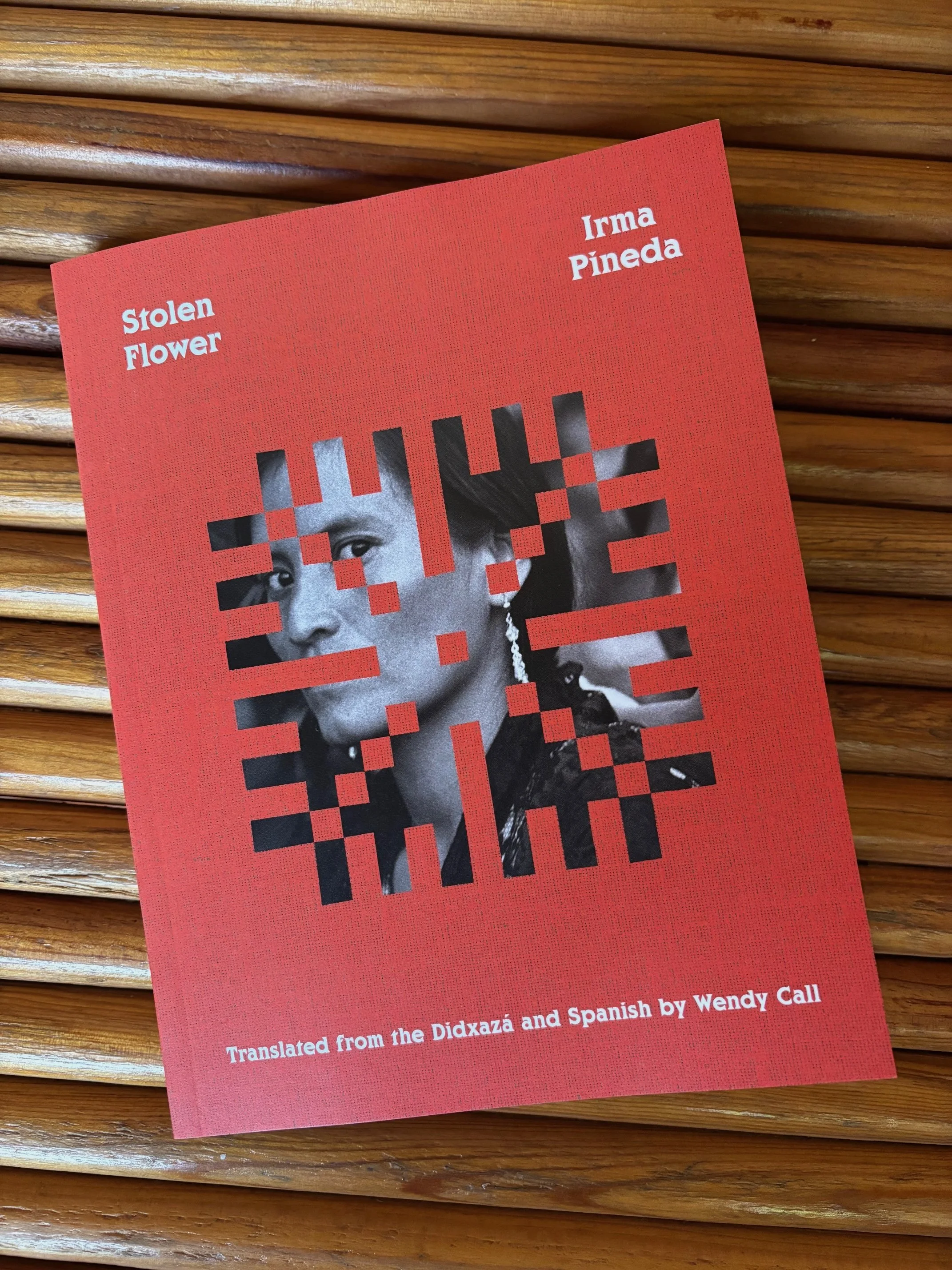
Stolen Flower, by Irma Pineda, is a trilingual edition from Yale University Press. (You can order it here.) This collection originally appeared in Mexico, in a bilingual Didxazá (Isthmus Zapotec) and Spanish edition, in 2013, which was republished in a large edition for libraries all over Mexico in 2023.
Stolen Flower is a highly compressed novel-in-verse, based on true events. In 2007, Mexican soldiers raped and left for dead a seventy-three-year-old Indigenous Nahua woman, Ernestina Ascencio Rosario, as she worked on her farm. Despite extensive evidence to the contrary, including eyewitness accounts, the courts ruled that Ascencio had died of natural causes. When journalists began to investigate, they discovered that there were numerous girls in the community who also had been raped by soldiers—girls as young as twelve who were already mothers. The reports sparked outrage throughout Latin America over violence against women and girls, violence against Indigenous communities, and military impunity. Stolen Flower makes art from that horrific series of events.
“Irma Pineda’s incantatory collection speaks truth to power in a voice that is prophetic, haunting, and hallucinatory, yet always brimming with humane compassion. Call’s translations are translucent and cutting as glass, offering these poems that already live in twinned bodies of Didxazá and Spanish the clear-eyed vision of a third.”
I am grateful to Cornell University’s Institute for Comparative Modernities and the University of Iowa’s MFA in Literary Translation for supporting my English translation of this book. Irma Pineda and I shared the 2022 John Frederick Nims Prize for Poetry Translation for three poems from this book that were published by Poetry.
“Irma Pineda’s poetry is urgent, at once fierce and full of compassion. It brings us face to face with our times, denouncing the violence that so often tears our communities apart, and envisioning alternative futures as only poetry can. And what a treat has Yale University Press prepared for multilingual readers worldwide. Long live translators, who, like Wendy Call, open paths for solidarity and awe.”
Read Lily Meyer’s lovely review of Stolen Flower, from Poetry.
You can read individual poems included in the collection in several literary journals. Please see links below:
Three poems at Poetry: in English (see links at bottom of that page) and the bilingual originals, with a short Translator’s Note
Three poems at Adi Magazine: rehumanizing policy
Three poems at Guernica